
Do a majority of Canadians want a law restricting abortion?
Well, it’s complicated.
We are aware of 40 polls on Canadians’ opinions on abortion since 2010. But each polling company asks different questions with different phrasing and different possible answers. And polling companies often change their questions from one poll to the next. While this variation can be useful to understand Canadians’ perspectives on abortion from various angles, it also leads to big discrepancies between answers.
The most common question in these polls is whether Canadians generally support unfettered access to abortion, support some restrictions on abortion, or support a (nearly) full ban. In what follows, we’ll group people who support some restrictions or a (nearly) full ban into a single group – those who support any restrictions.
Looking at all 22 polls that ask some variation on the question of whether respondents generally favour abortion restrictions or not, the median poll shows that Canadians are split. About 48% generally support completely unrestricted abortion, while 45% support some sort of legal restrictions.
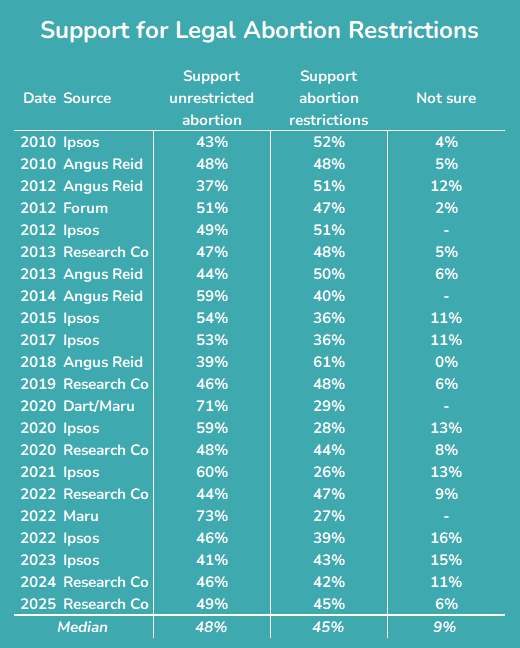
This data shows remarkably little variation. There are a few outliers that show unusual support for unrestricted abortion (e.g. 2020 Dart/Maru or 2022 Maru) or abortion restrictions (e.g. 2018 Angus Reid), but most polls aren’t too far off from the median. There is also relatively little variation over time. Support for unrestricted abortion is generally in the 40s at the beginning and the end of this set of opinion polls. Support for abortion restrictions has declined a bit from around the 50% mark to the low 40s, with the number of people who are not sure about their opinion rising commensurately.
Now those are Canadian’s opinions about laws on abortion generally. When abortion is just an abstract procedure, divorced from any specific circumstances, Canadians want abortion to be legal and available. But when asked about specific restrictions and specific circumstances, people become more supportive of restrictions on abortion.
For example, support for unrestricted abortion declines the older a pre-born child is. There is not a huge number of polls that ask Canadians about their support for abortion by gestational age, but there are a handful.
In 2011, Environics asked whether abortion should be legal or illegal in each trimester of pregnancy. Sixty-eight percent believed abortion should be legal in the first three months, 33% in the second three months, and only 16% in the last three months. Clear majorities opposed abortion being legal in the second trimester (58%) or third trimester (77%).
Two years later, Environics found that support for legal late-term abortion had increased. Seventy-one percent believed abortion should be legal in the first three months, compared to 21% opposed. Support for (43%) and opposition to (46%) abortion in the second three months was effectively tied. But only 25% supported legal abortion in the last three months, with 65% opposed.
Fast forward seven years, Maru (2020) found that support for legal first-trimester abortion reached 86% and increased to 57% in the second trimester and 30% in the last trimester.
That same year, Angus Reid found that 51% of Canadians agreed that women should have access to legal abortion at any time during a pregnancy. Forty-nine percent opined that there should be a law prohibiting abortion during the third trimester of a pregnancy unless the health of the mother is in danger.
In 2022, Ipsos released data in its global opinions of abortion poll that broke down support for abortion at various stages of pregnancy. In Canada, 69% thought that abortion should be legal in the first 6 weeks of pregnancy, 59% in the first 14 weeks of pregnancy, and 38% in the first 20 weeks of pregnancy.
When Ipsos ran the same poll in 2023, nearly the same number supported abortion in the first 6 weeks (68%), but support for abortion in the first 14 weeks declined to 54% and to 34% by 20 weeks.
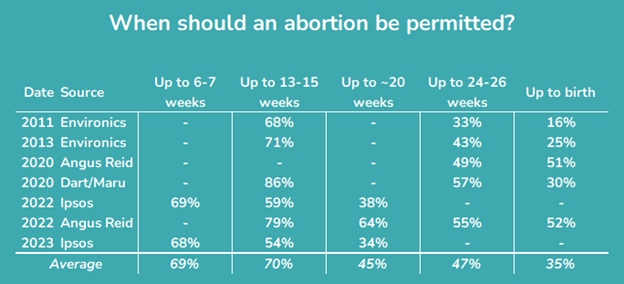
Although these polls ask about different gestational dates and sometimes have significantly different rates of support, the average across these polls paints a clearer picture. Approximately 69% of Canadians support legal abortion in the first trimester, but that support drops to an average of 47% by the end of the second trimester. Only 35% of Canadians support abortion in the third trimester.
And yet, Canada continues to abort approximately 1300 pre-born children in the least half of pregnancy each year.
All of these polls reveal significant opposition to restricting abortion, especially early in pregnancy. In many people’s minds, restricting abortion interferes with women’s freedom and autonomy. But attitudes change dramatically when you rephrase the question away from restricting abortion and toward protecting human life.
A trio of older polls (Abacus 2011, Environics 2011, and Environics 2013) asked Canadians when life should be legally protected. When phrased this way, less than a quarter (23%) support the status quo in which a child’s life is protected only after birth. Over a quarter (26%) of Canadians indicate that human life should be legally protected starting at conception. Fewer Canadians would pick 2 months (15%), 3 months (17%), or 6 months (10%) as the point at which pre-born lives should be protected.
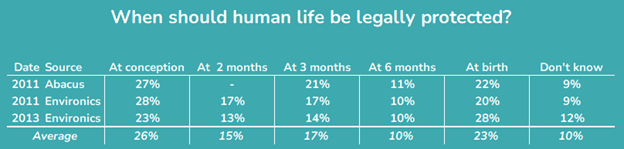
Across these polls, an average of 58% of Canadians think that human life should be protected from at least 3 months on, entailing restrictions on abortions in the second and third trimester.
Implications for pro-life advocacy
All of this is why WNAL employs an incremental strategy to restrict abortion. Unfortunately, most Canadians generally support legal abortion early in pregnancy, but that support dwindles when gestational age or other factors are considered. We might be a minority who oppose abortion entirely, but we are often in the majority when it comes to restricting abortion in certain circumstances.
Late-term abortion is one of those circumstances. When pre-born children are small or unrecognizable, many Canadians write them off as simply a clump of cells. But as a pre-born child grows and exhibits more signs of mature human life, adults increasingly recognize that child as worthy of protection. A pre-born child’s heartbeat begins around 6 weeks. A mother usually begins to feel her child move between 16-22 weeks. Pre-born children feel pain at 24-25 weeks at the latest.
As the humanity of the pre-born child becomes increasingly undeniable, support for abortion plummets. That’s why We Need a Law advocates for a ban on late-term abortions past 20 weeks. That’s approximately the point, according to public opinion polling, where support for legal abortion dips below 50%. Past 20 weeks, more Canadians oppose (or are uncertain about) late-term abortion than support it.
So go out there and gather this support and ask our governments to ban late-term abortion in Canada.
Appendix: List of Abortion Polls Since 2010