
Many pro-abortion advocates and academics insist that late-term abortions don’t happen in Canada.
For example, Action Canada for Sexual Health & Rights claims:
On Prince Edward Island, for example, abortion is only available until 12 weeks gestation. In Nova Scotia, until 16 weeks, and in New Brunswick, only until 14 weeks or 16 weeks (if you can pay for the procedure out-of-pocket). In Yukon and Nunavut, the gestational limit is 13 weeks… There are only three service locations in Canada that offer abortion up to 23 weeks and 6 days (one in British Columbia, one in Southern Ontario, and one in Quebec). No providers in Canada offer abortion care beyond 23 weeks and 6 days.
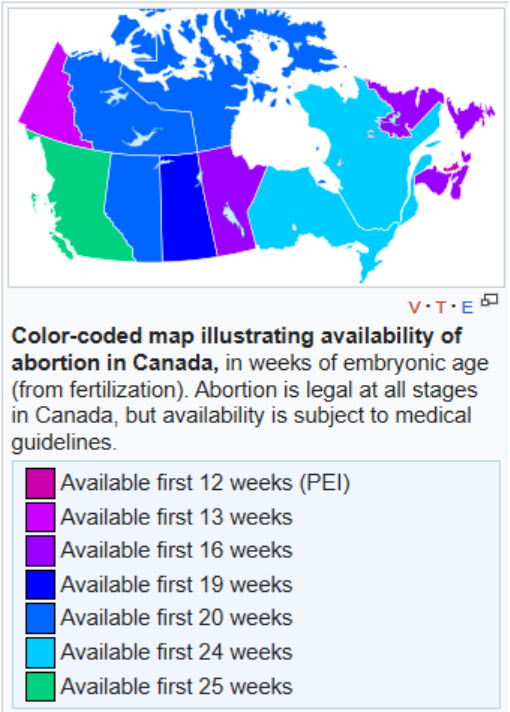
Wikipedia repeats this claim: “Nationally, abortion is legal through all nine months (40 weeks) of pregnancy, nevertheless no providers in Canada offer care beyond 23 weeks and 6 days.” Their page on abortion in Canada features the following graphic.
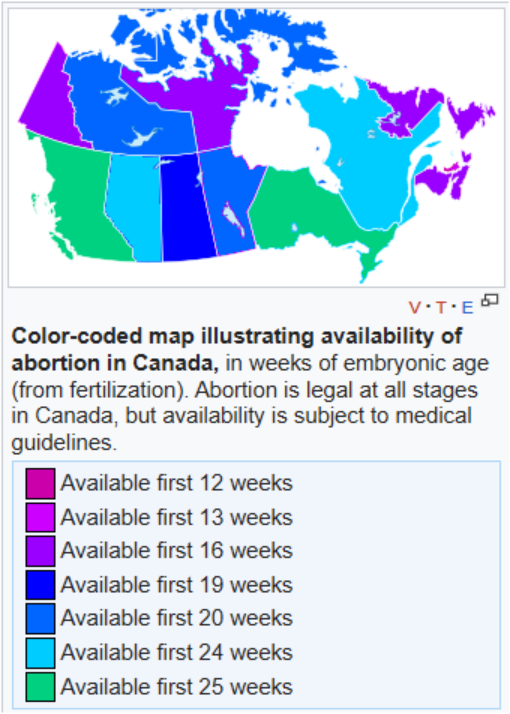
LEAF’s Abortion Access Tracker admits that “in recent years, a number of hospitals in Canada have started to offer abortion services after 24 weeks.” The tracker has adjusted what they call the “functional gestational limit” of some of the provinces, but still claims that no institution provides abortion over 25 weeks. According to the Abortion Access Tracker, the availability of abortion in Canada looks like this:
Defining late-term abortions
Of course, the chosen definition of late-term abortions will influence whether we think late-term abortions happen in Canada.
There is no universally agreed-upon definition of what counts as a late-term abortion. Abortions performed past the first trimester, or 13 weeks of gestation, are sometimes considered late-term abortions. Most abortions in Canada are performed in the first 13 weeks. Alternatively, the cut-off for late term abortions may be defined as past 20 weeks of gestation, that is, in the second half of a pregnancy. The Abortion Rights Coalition of Canada set the line for late-term abortion or “later abortions” at 20 weeks. Another definition views any abortion past viability as a late-term abortion. A majority of pre-born children can survive outside of the womb after 23 weeks of gestation. Finally, a late-term abortion can be defined as an abortion performed in the last trimester of a pregnancy (after 27 weeks).
But regardless of what definition is used, there is evidence that late-term abortions happen each year in Canada.
Late-term abortions over 20 weeks happen in Canada
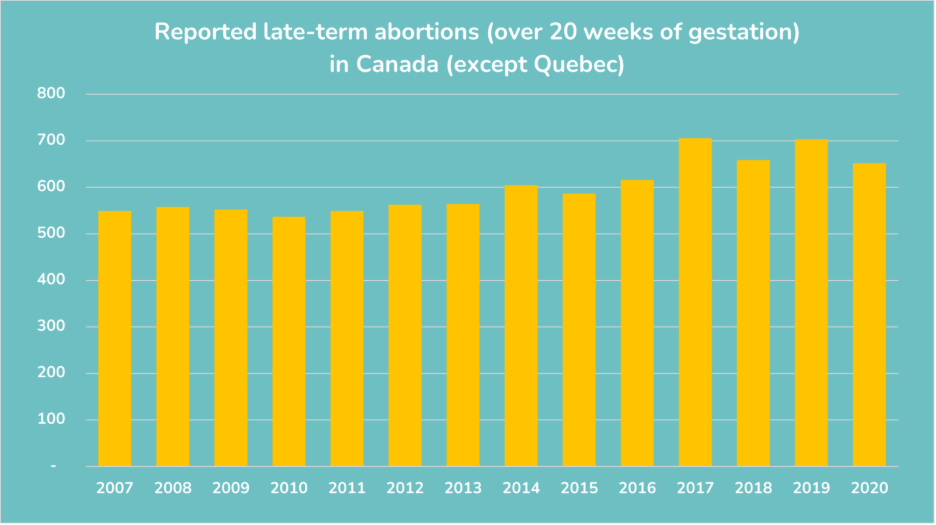
Most publicly available data on abortion is compiled by the Canadian Institute for Health Information (CIHI). From 2007-2020, CIHI published the gestational age of abortions performed in Canadian hospitals (excluding Quebec). Most hospitals provide detailed enough records that CIHI can report the gestational age of hospital-based abortions. Clinics, however, do not provide such detailed reports, and so CIHI cannot report on the gestational age of clinic-based abortions.
Below are two CIHI tables summarizing the number of abortions.
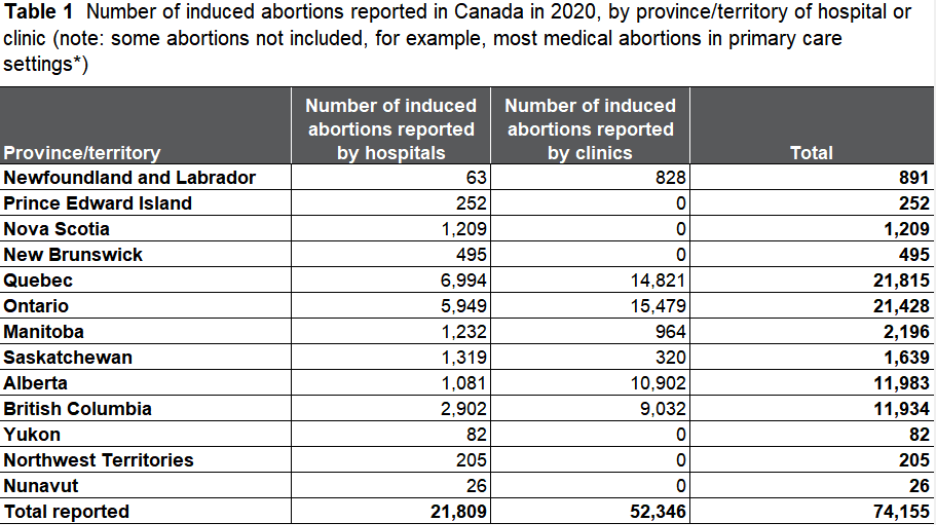
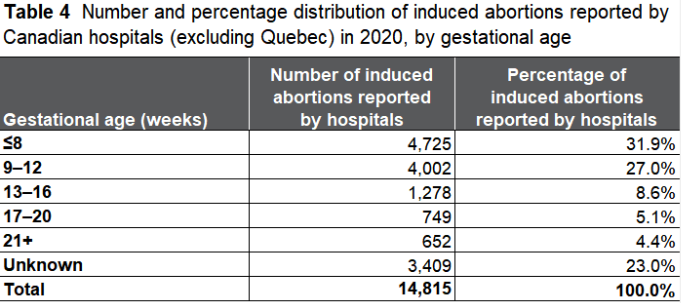
According to CIHI, 652 late-term abortions past 20 weeks were reported in 2020. That is the minimum number of late-term abortions performed each year. That equates to 4.4% of all reported hospital-based abortions and 5.7% of all hospital-based abortions for which the gestational age is known (excluding Quebec). This number has remained relatively steady, though it grew in the latter half of the last decade.
However, the real number of late-term abortions is likely quite a bit higher than this report.
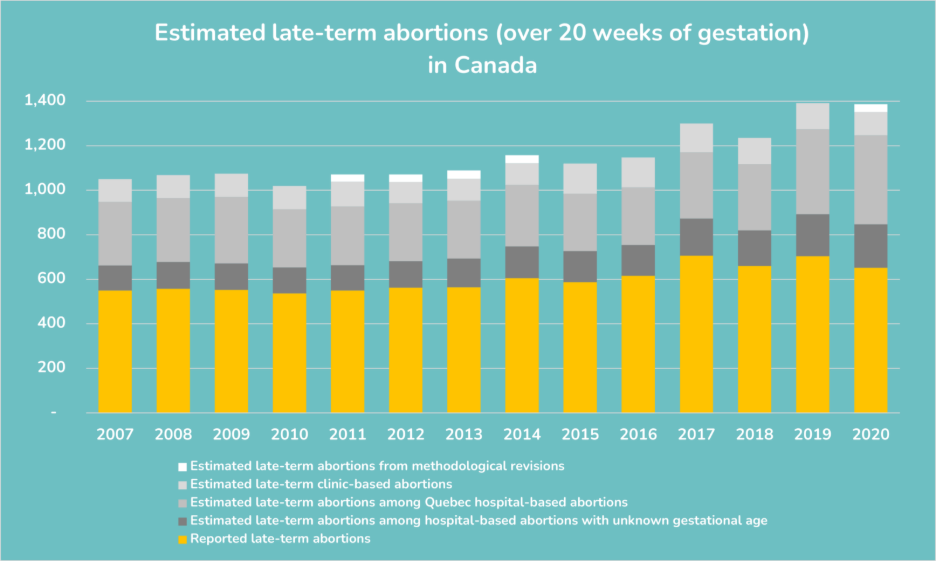
For starters, the gestational age of the pre-born child is not always reported. In 2020, almost a quarter of hospital-based abortions (excluding Quebec) had an unreported gestational age. If 5.7% of all these abortions were late-term abortions (the same percentage in the known gestational age category), that would add another 195 late-term abortions.
But that still leaves out Quebec, the second-largest province in Canada and the province with the most reported abortions. If Quebec had the same proportion of late-term hospital-based abortions as the rest of the country, that would add another 400 late-term abortions.
That still leaves out the 52,346 clinic-based abortions. Assuming that only 0.2% of all clinic-based abortions were late-term (the last reported figure available), another 105 late-term abortions would have occurred in abortion clinics.
And finally, CIHI later revised the number of abortions from 2020 upward by over 17,000 in subsequent years, due to an upgrade in their methodology. (CIHI has updated its methodology and revised the number of abortions on other occasions as well.) If all of these previously undercounted abortions occurred at abortion clinics and so 0.2% were late-term abortions, that would be an additional 35 late-term abortions.
| Estimated late-term abortions | 1,386 |
| Reported late-term abortions | 652 |
| Estimated late-term abortions among hospital-based abortions with unknown gestational age | 195 |
| Estimated late-term abortions among Quebec hospital-based abortions | 400 |
| Estimated late-term clinic-based abortions | 105 |
| Estimated late-term abortions from methodological revisions | 35 |
All of this yields a more realistic estimate of 1,386 late-term abortions across Canada in 2020. This is a conservative estimate, as CIHI notes that not all abortions are reported (particularly medical abortions provided or prescribed in a family doctor’s office), and it presumes a very low prevalence of late-term abortion at abortion clinics.
CIHI stopped reporting the gestational age of abortions in 2021, so there is no way to know or estimate the number of late-term abortions performed today. However, as the reported number of late-term abortions remained steady – and even increased – in the preceding years, nearly 1400 late-term abortions past 20 weeks likely continue happen in Canada each year.
But how about beyond 24 weeks?
Late-term abortions over 24 weeks happen in Canada
Last year, Alissa Golob from RightNow went undercover at three abortion clinics in Vancouver, Toronto, and Montreal. She had just started the second half of her pregnancy and was approaching the 24-week mark when her pre-born child would likely be able to survive out of the womb. She was told by a Toronto abortion clinic that a nearby hospital could provide her with an abortion up to 32 weeks’ gestation. Staff at the other abortion clinics implied that she could have an abortion even in the third trimester with no questions asked.
A 2015 study also backs up the fact that abortions past the 24-week mark are possible. This study surveyed 815 health care practitioners who frequently dealt with late-term abortion requests. The majority of respondents defined fetal viability as at 24 weeks’ gestation. Eighty percent of respondents said that their health care centre would offer “post-viability termination of pregnancy.” In other words, they would provide an abortion past 24 weeks.
Ninety-four percent reported that their institution does not have a hard gestation limit past which an abortion will not be offered (e.g. an abortion might be possible at any gestational age).
Even if their institution would not or could not provide an abortion past the point of viability, 76% of respondents said that they would refer a woman to a clinic in the United States, 21% to a clinic in another province, and 13% to a provider elsewhere in the same province for the abortion. Just because a given clinic or hospital would not provide a post-viability abortion in Canada doesn’t mean Canadians cannot get a late-term abortion elsewhere.
Both of these sources demonstrate that abortions past 24 weeks can happen. But do they happen?
To answer this question, we can turn to a 2024 academic study entitled Second-trimester abortion and risk of live birth. The study examined 13,777 second-trimester abortions in Quebec hospitals from 1989-2021. Now, the second trimester would include pregnancies between 15 and 29 weeks’ gestation. If Action Canada or Abortion Access Tracker are correct in their claim that no institution in Quebec provides abortions past 24 weeks, then we would expect this academic study would not be able to find any records of abortions between 24-29 weeks.
But they did.
The study found that, of these 13,777 second-trimester abortions, 720 abortions occurred between 25 and 29 weeks. This study reveals that abortions past 24 weeks’ gestation do occur in Quebec. Action Canada and Abortion Access Tracker’s claim that abortions don’t happen past 24 weeks in Quebec is false. And if those organizations are wrong about Quebec, might they be wrong about other provinces?
Now, the focus of this study was on live births after attempted abortions. The study found that, of the 13,777 second-trimester abortions, 1,541 resulted in a live birth. That is, the abortion failed to kill the child in the womb, so the child was born alive, and died within minutes, hours, or even up to a day after birth.
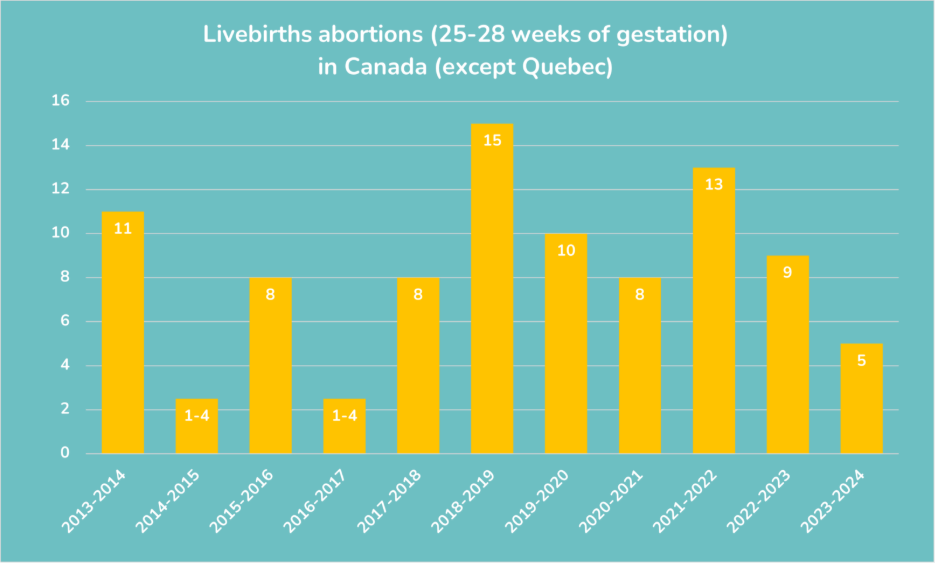
CIHI calls this outcome a “livebirth from termination of pregnancy” and publishes data on this tragedy in hospitals outside of Quebec for the last decade. Most of these livebirth abortions happen for pre-born children aged 21-24 weeks. However, an average of 8 livebirth abortions of pre-born children 25-28 weeks old occurred each year.
More proof of late-term abortions.
Late-term abortions over 28 weeks happen in Canada
But that’s not all.
The same dataset shows that an average of 5 livebirth abortions over 28 weeks’ gestation happened in the last decade. By 28 weeks, a child has over a 94% chance of survival after birth.
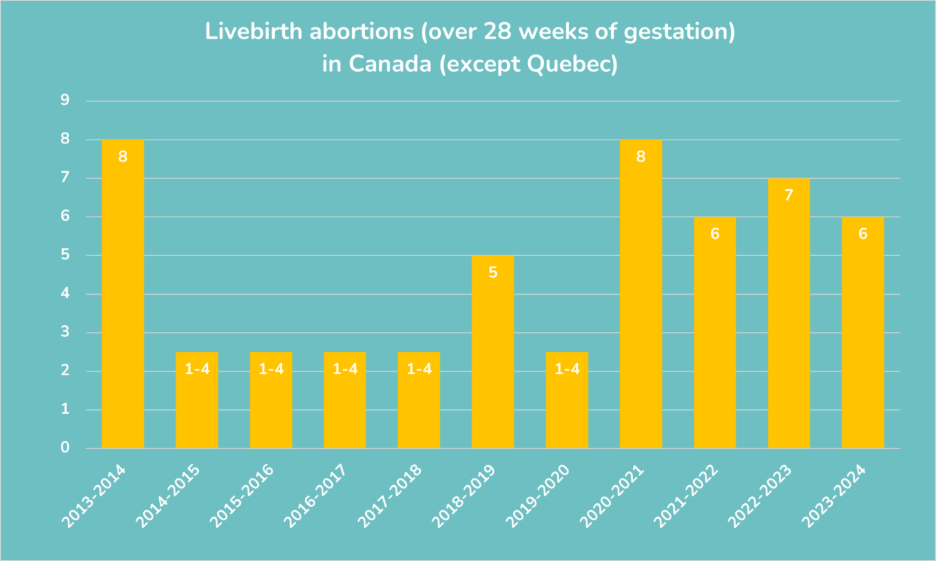
And we must remember that this is just one small piece of the puzzle: the number of third-trimester abortions that resulted in a live birth. This number may be small, but it leaves out all the pre-born children who were aborted and were not born alive, which is the expected (and, sadly, the intended outcome). And, again, that leaves out Quebec.
One news article from 2016 fills in a piece of the puzzle. The article reports that up to 24 third-trimester abortions were performed in Quebec alone in 2015. Another 17-42 Quebec women sought late-term abortions in the United States that year.
Finally, stories of late-term abortion rarely make the news, but some occasionally do. In 2015, one woman in Quebec had an abortion 35 weeks into her pregnancy at an unnamed Montreal hospital. In 2023, another story broke about an alleged abortion of a 38-week-old pre-born child at the Sacré Coeur Hospital in Montreal.
Late-term abortions do happen in Canada
These stories, studies, and statistics prove that late-term abortions do happen in Canada, despite claims to the contrary. And they happen regardless of the definition of “late-term.” In 2020, the last year for which we have gestational data, 652 abortions past 20 weeks were reported. A further unreported 734 are estimated to have been committed. Again, this is a conservative estimate that doesn’t consider abortions not reported to CIHI.
Data on second-trimester abortions in Quebec and livebirth abortions from CIHI confirm that abortions are also performed beyond 24 weeks, the generally accepted point of fetal viability. That same livebirth data and news reports in the media report that abortions in the last trimester of pregnancy (past 28 weeks) do happen in Canada.
This is why we need a law restricting late-term abortions in Canada. It is unconscionable that a pre-child can be aborted at any stage of pregnancy for any reason.