
On March 19, the Canadian Institute for Health Information (CIHI) released its annual abortion data for 2024. The number of reported abortions rose from 101,553 in 2023 to 102,705 in 2024. This is the second-highest number of abortions recorded in the last twenty years (after 108,784 abortions recorded in 2011).
This continues a new but distressing trend.
From 1974 until 1997, the number and rate of abortions grew. For the next twenty-five years, the number and rate of abortions generally declined, significantly increasing only in 2011 and 2020 when CIHI adjusted its methodology and began counting previously unreported abortions. In 2019, Canada saw the lowest number of reported abortions (83,576) since 1989 (79,315), the first full year after the Morgentaler decision struck down Canada’s law on abortion. In fact, the rate of abortion was lower in 2019 (9.8 abortions per 1000 women aged 15-49) than at any time since 1987.
However, the number of reported abortions has increased in each of the last three years, starting a new trend.
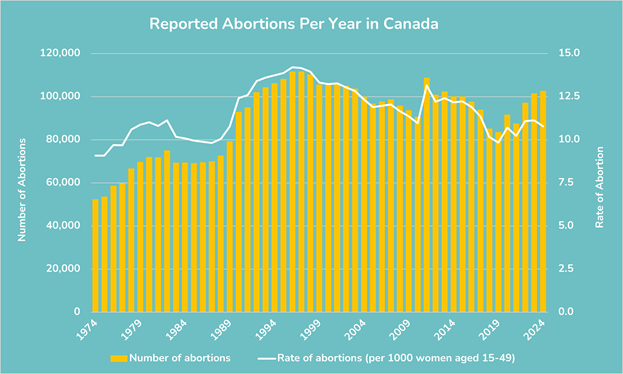
What’s driving this increase in abortion numbers but decrease in the abortion rate?
The main reason for the increase in the number of abortions in 2024 was the growth in the Canadian population; the number of Canadian women of childbearing age grew by almost 400,000 between 2023 and 2024. With more women of childbearing age, the number of abortions went up as well. Yet these numbers did not increase at the same rate. The number of abortions rose by only 1.1% while the number of women of childbearing age increased at nearly four times that rate (4.3%). This largely explains why the overall rate of abortion decreased from 11.1 abortions per 1000 women of childbearing age in 2023 to 10.8 in 2024, even though the number of abortions increased.
Another possible culprit for this decrease in the abortion rate is that an increasing number of abortions may be going unreported. Fewer abortions are being performed surgically and in hospitals where reporting is complete. More are medically triggered and are prescribed not only at abortion clinics but by family doctors (see below), where not all clinics or doctors are required to report abortions. These prescriptions from family doctors are less likely to be reported to CIHI. It is very possible that abortions that might have been performed in hospitals and abortion clinics and thus reported in years past are now being prescribed in doctors’ offices and not being counted.
It is also possible that women are experiencing fewer unplanned pregnancies and resort to abortion less often. Canadians are reporting less sexual activity than in years past. Some provinces are starting to make prescription contraception free. Canada’s fertility rate drops lower every single year, suggesting that there are fewer pregnancies every year.
What else does the abortion data tell us?
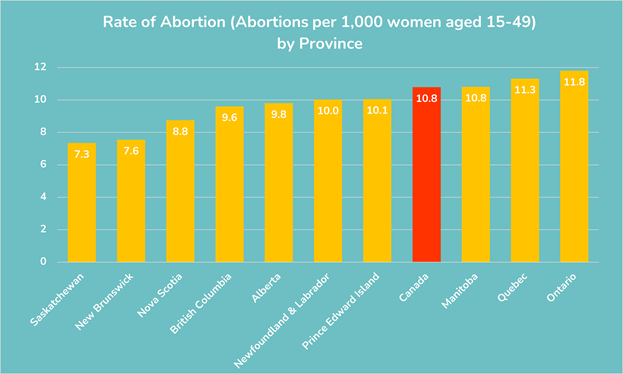
First, the rate of abortion varies across the country. Most provinces are below the Canadian average, with Saskatchewan and New Brunswick having the lowest rate (though this may be because these are the only two provinces that don’t fully report abortion clinic data). Manitoba sits right at the Canadian average, while Quebec and Ontario have the highest rates of abortion. Since 2019, the recent low point for the number and rate of abortion, the rate of abortion has increased in six provinces – led by Ontario and New Brunswick – and decreased in four provinces – mostly in Quebec and Alberta.
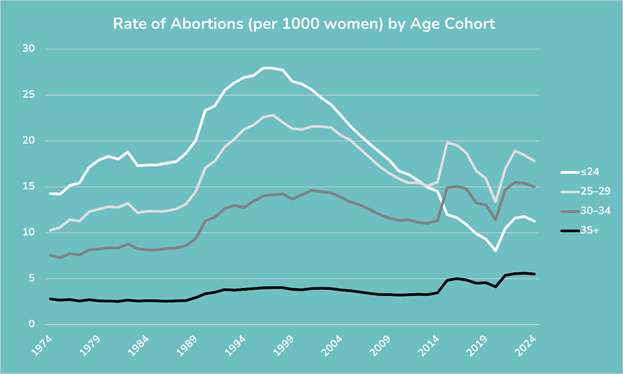
Second, the age of women who are aborting their children is changing. Women aged 25-29 are the most likely to have an abortion (17.8 abortions per 1000 women). They are closely followed by women aged 30-34 (15.0 abortions per 1000 women) and aged 18-24 (14.2 abortions per 1000 women). The rate of abortion for women aged 35+ is only 5.5 abortions per 1000 women. Girls aged 15-17 have the lowest rate of abortion at 3.4 abortions per 1000 women.
Until about 2013, women below the age of 25 were the most likely to have an abortion. This became the stereotype of a young woman in high school or college or just starting a job choosing to have an abortion. But the rate of abortion for these young women is now about half of its peak 20 years ago (22.8 abortions per 1000 women in 2004 vs 11.3 in 2024). The rate of abortion has also declined slightly for women aged 25-29 in that time period (20.6 abortions per 1000 women in 2004 vs 17.8 in 2024).
The opposite is true for older women. In the last 20 years, abortion rates have increased marginally for women aged 30-34 (13.9 abortions per 1000 women in 2004 vs 15.0 in 2024) and women over the age of 35 (3.8 abortions per 1000 women in 2004 vs 5.5 in 2024).
Abortions have also increasingly moved out of the hospital setting. In 2008 (as far back as the data goes), 46.3% of all abortions happened in a hospital, and 53.7% occurred in a non-hospital setting, generally specialized abortion clinics. In 2024, only 20.3% of abortions happened in a hospital. That is a big shift towards abortion at specialized clinics, in family doctors’ offices, and at home.
Abortions are increasingly being done medically, rather than surgically. CIHI doesn’t have consistent data going very far back for the method of abortion but, in just the last three years, the percentage of abortions done surgically fell by over ten percent. The percentage done medically (through, for example, the abortion pill) has increased commensurately. With 52.5% of all abortions being done surgically and 47.5% using medication in 2023, medical abortion will likely be the dominant form of abortion in the reported statistics in just a year or two.
Conclusion
It is heartbreaking to see abortion numbers rising. This means more women are facing pregnancy with fear and a lack of support. It means our pro-abortion federal and provincial governments have successfully sold the lie that abortion is a necessity, or a right, or part of health care. Abortion is none of these things. It is the deliberate killing of a vulnerable pre-born child in what should be one of the safest places in the world.
There is much work to be done to educate the public on the humanity of pre-born children, and the right to life that should come with that. Too many women have bought the lie that children are a burden, a limitation, and ultimately expendable. Together, the pro-life movement in Canada must continue to speak up for those who cannot speak for themselves.